Market Intelligence vs Competitive Intelligence: Which Does Marketing Actually Need?
Here's what separates market intelligence and competitive intelligence, and how to use both effectively.
Market intelligence and competitive intelligence are two terms that get used interchangeably often enough that the confusion is understandable. In some corners of the industry, they're treated as synonyms. In others, one is considered a subset of the other. The academic definitions don't fully agree, and neither do practitioners.
For marketing teams, though, the distinction is worth making — not as a semantic exercise, but as a practical one. The two types of intelligence answer different questions, draw on different data sources, and inform different decisions. Treating them as the same thing tends to mean doing neither particularly well.
This article breaks down what separates them, where they overlap, and how to decide which one your team should be prioritising right now.
The One-Line Distinction
The simplest way to separate them is by scope.

Think of it like a chess game. Market intelligence tells you how the board works, which positions matter, and how the game tends to unfold. Competitive intelligence tells you how the specific player sitting across from you likes to move.
What Is Market Intelligence (for Marketing Teams)?
Market intelligence is the ongoing process of monitoring everything outside your organization that could affect how you market, position, and grow — industry trends, shifts in customer behavior, emerging technologies, economic signals, and category dynamics. It's not a report commissioned before a product launch. It's a continuous system that runs in the background and surfaces relevant signals before they become obvious.
For marketing teams specifically, market intelligence operates at the strategic layer. It informs where the category is heading, how consumer priorities are shifting, and what the broader market context looks like when it's time to make decisions about brand positioning, GTM timing, or budget allocation.
Let's give an example. A CPG brand's market intelligence system starts picking up a sustained rise in consumer conversation around gut health — not as a niche wellness topic, but as a mainstream purchase driver showing up across search data, social platforms, and retail trend reports. That signal, detected early enough, opens a window: reformulate an existing product, reposition a current range, or develop something new before the category gets crowded. The brands that act on that signal six months before it peaks are the ones that own the conversation when it does.
What Is Competitive Intelligence (for Marketing Teams)?
Competitive intelligence is the focused, ongoing process of tracking what your rivals are doing — their messaging, positioning, product launches, pricing moves, ad creative, content strategy, and even hiring signals. Where market intelligence casts a wide net across the full external environment, competitive intelligence narrows the lens to the specific players you're competing against directly.
For marketing teams, the core questions competitive intelligence answers are immediate and tactical: What are competitors saying right now, and to whom? How are they positioning against us? Where are they investing, and where are they pulling back? The answers feed directly into positioning decisions, messaging strategy, and campaign planning, giving teams something concrete to respond to rather than assumptions to plan around.
Take the same CPG brand from the previous example. While their market intelligence system is tracking the broader gut health trend, their competitive intelligence layer picks up something more specific — a competitor has started running heavy performance spend on digestive health product lines across Meta. That's the kind of early warning that changes a campaign brief, accelerates a launch timeline, or prompts a repositioning conversation before the competitor has finished their own planning cycle.
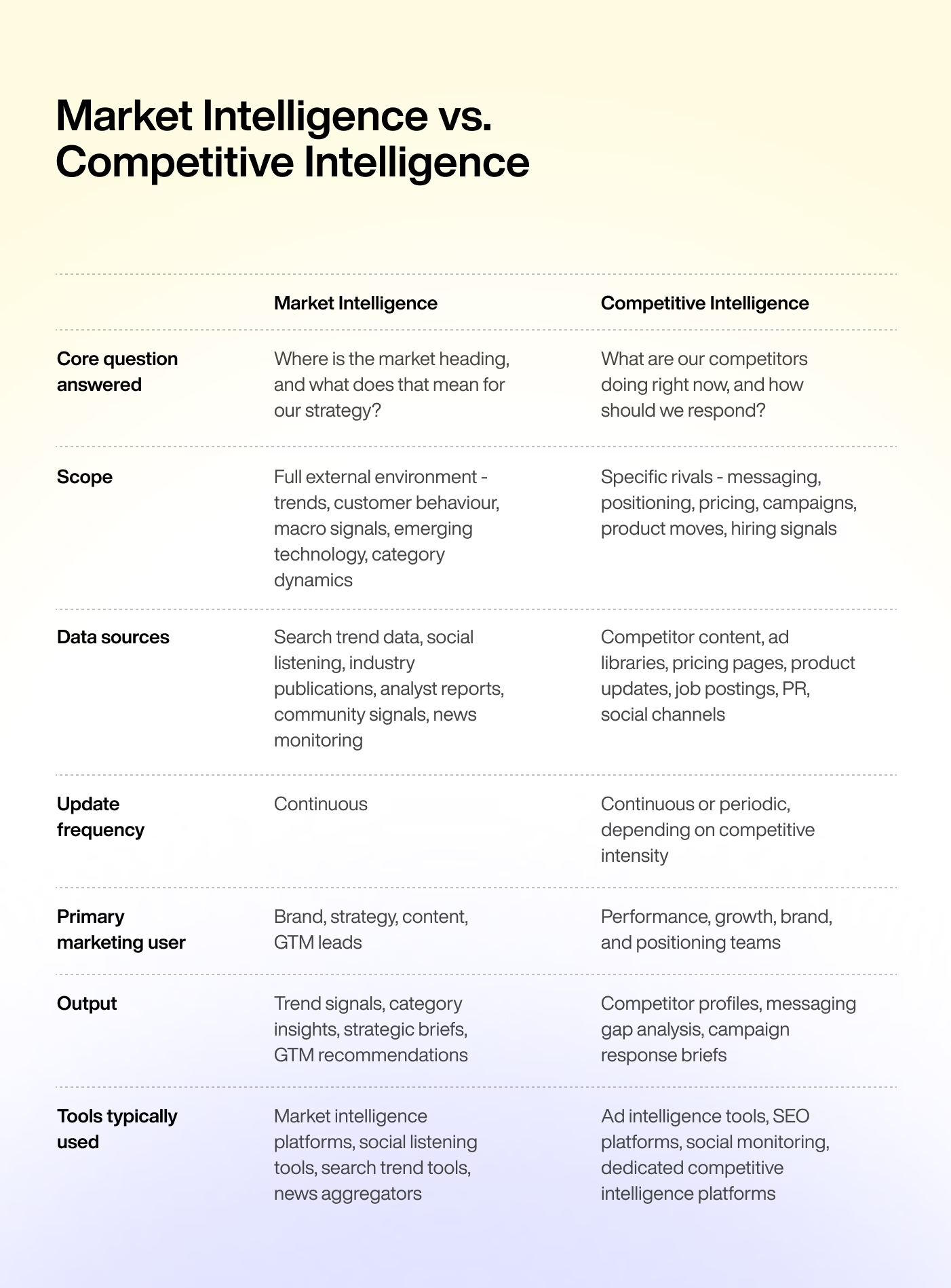
Market Intelligence vs Competitive Intelligence: Side-by-Side
Different questions, different data, different decisions — here's how the two compare across the dimensions that matter most for marketing teams.
Where They Overlap
The clean separation in the comparison table above is useful for understanding what each type of intelligence does. In practice, though, the line blurs. But that's not a problem to fix. It's a sign the system is working the way it should.
Competitive intelligence isn't a parallel discipline to market intelligence. It's a component of it. A complete market intelligence system includes competitor monitoring as one of its inputs, alongside trend data, customer signals, and macro indicators. The mistake is treating competitive intelligence as a standalone function that operates separately from broader market monitoring.
Several intelligence activities serve both simultaneously. Social listening is the clearest example — a single data stream that captures rising consumer trends and shifts in competitor messaging and positioning at the same time. Win/loss analysis is another: the reasons customers choose you or a rival generate both customer understanding that feeds market intelligence and competitive insight that feeds competitive intelligence. Separating these into different workstreams means the same data gets analyzed twice, or not at all. For context on how market intelligence relates to market research specifically, and where the two overlap in practice, see Market Intelligence vs Market Research.
The best intelligence functions don't maintain a hard boundary between market intelligence and competitive intelligence. They feed both into the same strategic system, where signals from different sources inform each other. A trend detected through market intelligence context might explain a competitor's move spotted through competitive intelligence, and vice versa. Platforms like Recommend are built around exactly this — capturing signals across market trends, customer behavior, and competitor activity in a single system, so the intelligence your team acts on reflects the full picture rather than one slice of it.
The Terminology Debate
Any article about market intelligence vs competitive intelligence that ignores the terminology debate isn't giving you the full picture.
Within the competitive intelligence community — particularly among practitioners associated with SCIP (the Strategic and Competitive Intelligence Professionals organization) — the prevailing view is that competitive intelligence is the correct umbrella term, encompassing market trends, customer insight, and competitor monitoring under a single discipline. From this perspective, what we're calling market intelligence is simply competitive intelligence done broadly. Others use the terms interchangeably without much thought, treating them as regional or stylistic variants of the same concept.
These aren't fringe positions. They reflect genuine disagreement about how the discipline should be defined, and anyone working in this space will encounter both framings.
The distinction this article draws — and that most marketing-focused frameworks use — is a practical one, not an academic claim. For marketing teams specifically, separating the broad market monitoring function from the competitor-specific tracking function helps clarify what data to prioritise, which team should own it, and what decisions each type of intelligence is meant to support. It's a working framework, not a bid to settle a semantic debate that the industry hasn't settled in decades.
If your organization uses competitive intelligence as the parent term and treats market monitoring as a subset of it, the framework still applies — the labels are less important than the underlying distinction between broad external monitoring and focused competitor tracking.
Which Should Marketing Teams Prioritise?
The honest answer is that most mature marketing functions need both. But not every team is at the same stage, and not every function has the same immediate needs. Here's a practical framework for where to start.
Early-stage or fast-growing brands. Start with competitive intelligence. Before investing in broad market monitoring infrastructure, you need a clear picture of the competitive landscape — who you're up against, how they're positioned, where their messaging is strong, and where it isn't. That understanding shapes everything from your positioning to your content strategy, and it's harder to build without knowing who you're differentiating from.
Category leaders. Shift the emphasis toward market intelligence. When you're the brand competitors are reacting to, tracking their moves is less urgent than tracking where the market is heading. The strategic risk for category leaders isn't being outmanoeuvred by a rival — it's missing a category shift that a challenger spotted first.
Content and brand teams. Market intelligence is more immediately useful. Editorial and creative strategy runs on trend signals — what audiences are starting to care about, which conversations are gaining momentum, where cultural attention is moving. Competitive intelligence informs positioning, but it's the market intelligence that tells content teams what to actually make.
Performance and growth teams. Competitive intelligence tends to be more directly actionable. Competitor ad creative, messaging shifts, and pricing moves have immediate implications for campaign strategy, bidding decisions, and conversion positioning. The feedback loop between competitive intelligence signals and performance decisions is short enough that continuous monitoring pays off quickly.
Teams in disrupted categories. You need both, and you need them running simultaneously. When a category is being reshaped — by new technology, a regulatory shift, or an aggressive new entrant — market shifts and competitive moves happen on the same timeline. Prioritizing one over the other means missing half the picture.
For a step-by-step guide to setting up the system, see How to Build a Market Intelligence Strategy.
FAQ
Is competitive intelligence a type of market intelligence?
In the framework most useful for marketing teams — yes. Competitive intelligence is one component of a broader market intelligence system, focused specifically on rival strategies, messaging, and positioning. That said, the industry doesn't fully agree on this. Some practitioners, particularly in the SCIP community, treat competitive intelligence as the parent discipline and market intelligence as a subset of it. The labels matter less than understanding what each type of intelligence is for and making sure your team is doing both.
Can one platform do both?
Increasingly, yes. Earlier generations of intelligence tools tended to specialise — social listening platforms for trend monitoring, dedicated competitive intelligence tools for competitor tracking. AI-native platforms now capture signals across market trends, customer behaviour, and competitor activity in a single system, which removes a lot of the operational friction that came with running separate tools for separate functions.
How does competitive intelligence differ from competitor research?
Competitor research is typically a one-off exercise, an audit of the competitive landscape conducted before a planning cycle, a rebrand, or a market entry. Competitive intelligence is continuous. It monitors rival moves in real time, tracks shifts in messaging and positioning over time, and surfaces signals that a periodic audit would miss entirely. The difference is the same as the difference between a snapshot and a feed.
Which team should own competitive intelligence vs market intelligence?
In practice, ownership depends on how the marketing function is structured. Competitive intelligence tends to sit closest to performance, growth, and brand strategy teams — the functions that need to respond to competitor moves quickly. Market intelligence is more naturally owned by brand strategy, content, or a centralised insights function, given its longer time horizon and broader scope. In smaller teams, both often fall to the same person or function, which is a reasonable starting point as long as both are actually being done. The risk to avoid is neither being owned clearly, which is how both end up deprioritised.