How to Build a Market Intelligence Strategy That Actually Informs Decisions
A practical, step-by-step framework for building a market intelligence strategy that actually informs decisions.
Most marketing teams aren't short on data. There are industry reports, social listening dashboards, analytics platforms, competitor audits… The inputs keep multiplying faster than anyone has time to process them. The problem isn't access to information. It's the absence of a system for turning that information into decisions.
Without that system, nothing accumulates. Every planning cycle starts from roughly the same place — re-learning competitive dynamics, catching trends after they've already moved, and filling the gaps with assumptions that made sense twelve months ago. The brands that consistently make better decisions aren't necessarily smarter. They've built a process that the others haven't.
This article walks through that process step by step. It's a practical framework for building a market intelligence strategy designed specifically for marketing teams, from defining the right questions to activating intelligence across the functions that need it most.
What Makes a Market Intelligence Strategy Different from Just 'Collecting Data'
Most teams that think they have a market intelligence function actually have a data collection habit. The distinction matters more than it might seem.
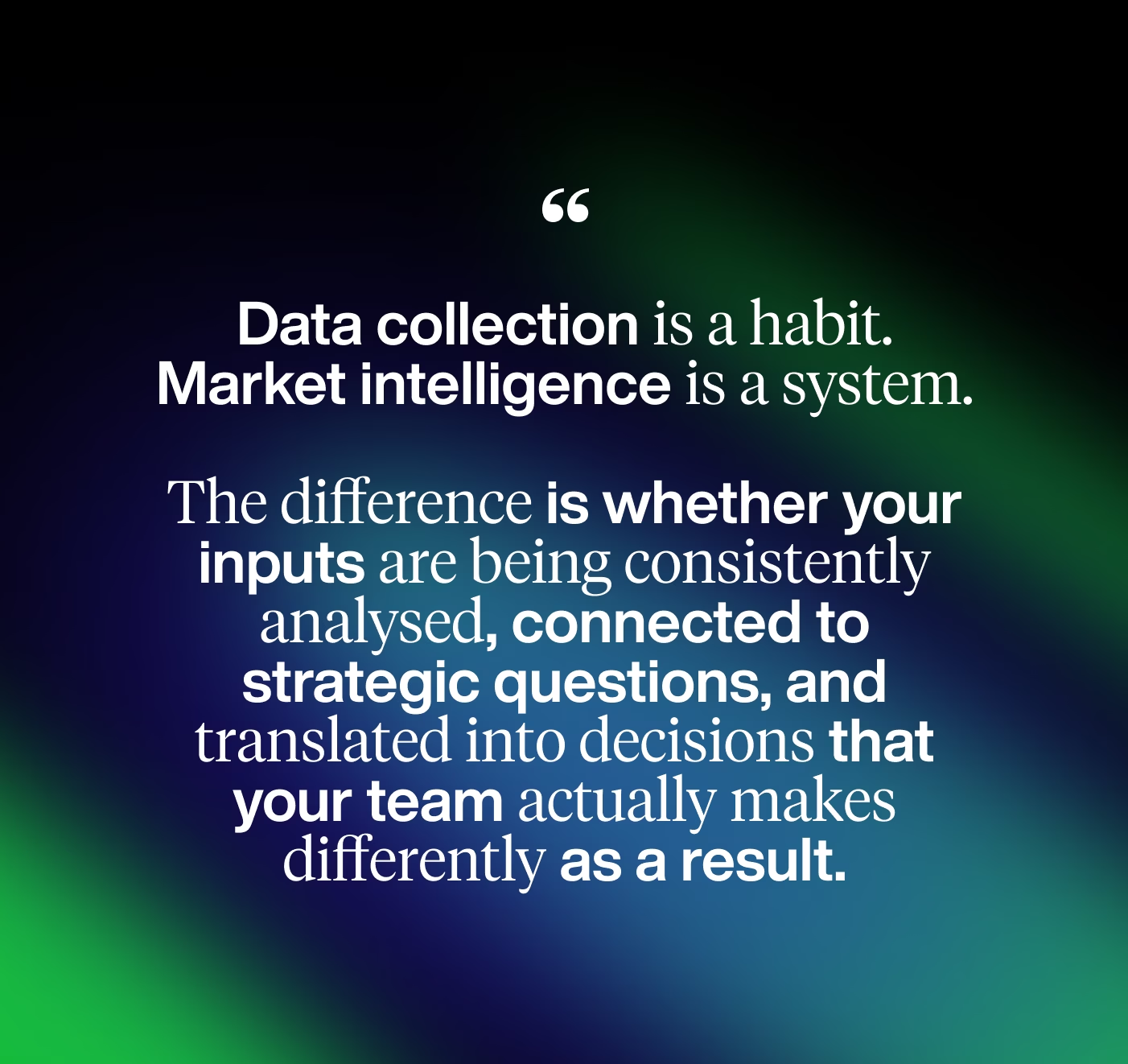
Without that connective tissue, inputs stay inputs — useful in theory, but not doing much in practice.
Three failure modes show up repeatedly in marketing teams that haven't made that shift.
Too broad, no prioritisation. Monitoring everything sounds thorough. In practice, it produces a volume of signals that nobody has time to process, which means the most important ones get buried alongside the irrelevant ones. Intelligence without scope becomes noise, and noise gets ignored.
One-time research mistaken for ongoing intelligence. A commissioned study answers the question it was designed to answer, at the time it was designed. Filing those results and treating them as a live picture of the market is one of the most common ways teams fall behind. Markets move, but a static deliverable doesn't.
Insight without activation. This is the most expensive failure mode because it wastes the most effort. Teams that produce rigorous analysis but have no clear process for distributing it, connecting it to decisions, or measuring whether it changed anything end up with great decks and unchanged behaviour. Intelligence that doesn't influence decisions has no value, regardless of how good the analysis was.
Step 1 — Define Your Key Intelligence Questions
This is the most important step in building a market intelligence strategy, and the one most teams skip entirely.
Key intelligence questions (KIQs) are the standing strategic questions your market intelligence system exists to answer continuously. They aren't project-specific; they don't expire when a campaign launches or a planning cycle closes. They persist because the decisions they inform persist.
For a marketing team, well-formed KIQs look something like this:
How is consumer sentiment toward our brand evolving relative to our top three competitors?
Which emerging trends in our category are gaining search momentum before they hit mainstream coverage?
How is competitors' content and messaging strategy shifting quarter over quarter?
Which customer segments are showing early signals of changing purchase behaviour?
What macroeconomic or regulatory signals could affect our category in the next 12 months?
A few principles for getting these right. Start with four to six KIQs. Any more and focus breaks, which defeats the purpose of having them. Each one should map directly to a decision your team will actually make: a positioning call, a budget reallocation, a content calendar pivot, a product roadmap input. If a KIQ doesn't connect to a real decision, it's an interesting question, not an intelligence priority.
The test for a good KIQ is simple: if the answer changed tomorrow, would your team do something differently? If yes, it belongs in the system. If not, cut it.
Step 2 — Define Your Scope
Once you have your KIQs, the next question is what the system needs to monitor to answer them, and who inside the organization it's actually serving. Leaving either of these undefined is how market intelligence strategies become unwieldy.
What you monitor. This means being explicit about which markets, geographies, product categories, customer segments, and competitor sets are in scope. The instinct is to monitor everything, but a tighter scope produces sharper intelligence. Broader isn't better — it's just more to process. A system scoped to three core competitors in two geographies will produce sharper, more usable insight than one trying to track an entire industry across every market simultaneously.
Who are you monitoring it for. Different internal audiences need different things from the same intelligence system. A brand strategy team needs trend lines and category signals. A content team needs rising topics and emerging consumer language. A performance team needs competitor messaging and keyword shifts. Executive leadership needs the two or three findings that actually change strategic assumptions. If the system produces one undifferentiated output for everyone, most of it will be ignored by most people.
The most common scoping mistake is trying to cover everything in an attempt to be comprehensive. A well-scoped market intelligence strategy that answers five questions excellently — with clear owners, clear cadence, and clear connection to decisions — is worth considerably more than a poorly-scoped one that generates fifty data points and no clear action.
Step 3 — Map Your Data Sources
With your KIQs defined and scope set, the next step is identifying where the intelligence actually comes from. There are two categories of sources, and most teams over-invest in one while largely ignoring the other.
External sources tell you what's happening in the market.
Search data. Google Trends, keyword tracking tools, and rising query monitoring reveal what audiences are starting to care about before it shows up anywhere else. Search behaviour is one of the earliest leading indicators available to a marketing team.
Social listening. Sentiment tracking, emerging topics, and consumer language across platforms — particularly in niche communities and forums where trends often originate before going mainstream.
News and industry media. Trade press, mainstream media coverage, and analyst commentary surface category shifts, regulatory signals, and emerging narratives that broader data sources may not yet reflect.
Competitor tracking. Website changes, product launches, pricing updates, job postings, and ad creative. Hiring signals in particular are an underused source — a competitor suddenly recruiting for a new function tells you something about where they're heading. For a deeper look at how competitive intelligence fits into a broader intelligence system, see our full comparison.
Consumer and market research. Commissioned studies, syndicated reports, and government data provide structured evidence to validate signals picked up through other sources. For the distinction between this and ongoing market intelligence, see market intelligence vs market research.
Internal sources tell you what your own data reveals about the market.
CRM and sales data. The conversations your sales team is having with prospects and customers contain market signals that never make it into a dashboard. Recurring objections, shifting purchase motivations, and new competitive mentions are all intelligence worth capturing.
Customer feedback and support. Recurring themes in complaints, reviews, and NPS responses reveal how customer expectations are shifting, and often before that shift shows up in broader market data.
Website analytics. Which content is gaining organic traction? Which search terms are driving traffic you didn't anticipate? Your own site behaviour is a real-time signal about rising audience interest.
Campaign performance data. Which messages are resonating with which segments, and which aren't? Performance patterns across campaigns are market signals, not just creative feedback. What lands and what doesn't tells you something about how your audience is thinking right now.
The principle that most market intelligence frameworks understate: external and internal sources answer different questions, and combining them produces a picture that neither can provide alone. External sources tell you what's happening in the market. Internal sources tell you how your brand is sitting within it. A system that draws on both gives you context that a competitor monitoring only one side of that equation simply won't have.
Step 4 — Build Your Collection and Monitoring System
Knowing what to monitor is one thing. Having a reliable system for monitoring it consistently is another. This is the step where process meets infrastructure.
Manual vs automated. Starting manually is fine. It forces clarity about what actually matters before committing to tooling. But manual monitoring doesn't scale. At a certain point, the volume of signals across sources exceeds what any team can process without missing things, and the gaps tend to appear exactly where they're most costly.
What to automate first. Not everything needs to be automated simultaneously. For most marketing teams, the highest-value starting points are competitor tracking, news and trade press monitoring, and search trend alerts. These are high-frequency, time-sensitive signal types where a delay of even a few days can mean the difference between acting on intelligence and reacting to news.
AI-powered platforms. The monitoring category has shifted significantly. Modern market intelligence platforms scan hundreds of sources simultaneously, apply relevance filtering against your specific KIQs and scope, and surface emerging signals before they reach peak mainstream visibility, which is precisely the window where intelligence has the most strategic value. Recommend is built around this workflow, connecting real-time signal detection directly to the activation layer where briefs, content, and campaigns get made.
Cadence. A monitoring system without a rhythm defaults to whenever someone remembers to check it, which is not a system. Set a clear cadence: daily alerts for fast-moving signals like competitor activity and breaking category news; weekly synthesis for trend patterns; monthly review of KIQs against incoming signals; quarterly strategic update for leadership. The cadence should match the speed at which decisions get made in your organisation.
Step 5 — Establish an Analysis Framework
Collecting signals is the easy part. Turning them into intelligence requires a layer of analysis that most teams either skip entirely or handle inconsistently. Raw data points don't make decisions, but patterns do. And patterns require a framework for recognizing them.
Signal vs noise. Not every data point that enters the system is worth acting on. The analysis framework defines the threshold: what triggers action, what gets logged for future reference, and what gets discarded. Without that filter, every signal competes equally for attention, which means the genuinely important ones don't get the response they warrant.
Pattern recognition over point-in-time snapshots. A single data point tells you where something sits today. A series of data points tells you where it's heading. The value of market intelligence compounds significantly when analysis tracks how signals evolve over time. A gradual rise in consumer conversation around a topic is a very different strategic input than a one-week spike. Teams that only look at the current state miss the directional information that makes intelligence actionable.
Established frameworks as scaffolding. SWOT, PESTLE, and Porter's Five Forces aren't mandatory, but they're useful starting structures, particularly for teams building an analysis process for the first time. They provide a consistent lens for organising incoming signals and ensuring the analysis covers the right dimensions. The goal isn't methodological rigour for its own sake. It's making sure the same types of signals get evaluated the same way each cycle.
Cross-source validation. A signal appearing in a single source might be noise, an anomaly, or an artefact of that source's particular methodology. The same signal appearing independently across three separate sources — search data, social listening, and trade press, for example — is intelligence worth acting on. Cross-source validation is what separates a genuine emerging trend from a distortion, and it's the step that gives your team confidence to brief a campaign or shift a budget before the signal hits mainstream visibility.
Step 6 — Activate: Turn Intelligence into Decisions
This is the step that determines whether the previous five were worth the effort. A market intelligence system that produces insight nobody acts on is an expensive research habit, and not a strategic asset. Activation is what separates the two.
Match intelligence to decisions. For each KIQ, define in advance what the team would do differently if the answer changed. If a shift in competitor messaging would trigger a positioning review, that's a real KIQ. If the answer could change significantly and nobody would do anything differently as a result, the question doesn't belong in the system. This mapping exercise is also the most effective way to build internal buy-in. When stakeholders can see exactly how intelligence connects to decisions they already own, the system stops feeling like overhead.
Build distribution into the system, not as an afterthought. A quarterly deck presented to leadership once and filed is not distribution — it's a report. Real distribution means intelligence reaches the people who need it, in the format they can use, at the cadence that matches their decision rhythm. That means searchable access for teams that need to pull context on demand, real-time alerts for fast-moving signals, and team-specific views that surface what's relevant to each function without burying it in everything else.
Format for the audience. Strategy teams need trend lines and scenario inputs. Content teams need rising topic signals and emerging consumer language. Performance teams need competitor messaging shifts and keyword movement. Leadership needs the two or three findings that actually change strategic assumptions, and not a comprehensive summary of everything the system detected. The same intelligence, packaged differently, gets used. Packaged uniformly, most of it gets ignored.
Closing the loop between intelligence and activation is where platforms like Recommend earn their place in the system. The point is to connect the signal detection layer directly to briefing, content creation, and campaign execution, so the gap between insight and action is measured in hours rather than planning cycles.
Step 7 — Review, Measure, and Improve
A market intelligence strategy doesn't have a completion date. It's a loop that compounds in value over time, but only if it's being actively maintained and measured against the right things.
Revalidate your KIQs every quarter. Business priorities shift, categories move, and the questions that mattered six months ago may not be the ones driving decisions today. A quarterly KIQ review doesn't mean rebuilding the system. It means checking that what the system is answering still maps to what the team needs to know. Add what's become relevant. Remove what's no longer connected to a real decision. Keep the list tight.
Measure program value, not data volume. The temptation is to measure market intelligence by its outputs — reports produced, sources monitored, signals flagged. None of those metrics tells you whether the system is working. The right metrics are decision-oriented: How quickly did the team respond to a significant competitor move? How many campaigns were built around trends before they peaked rather than after? How much of the content calendar was informed by rising demand signals rather than last year's performance data? Define those KPIs early, before the system is running, so you have a baseline to measure against.
Institutional memory. This is the compounding advantage that makes a mature market intelligence system significantly more valuable than a new one. Each analysis cycle should build on the last. Patterns become clearer, baselines become more accurate, and the team's ability to distinguish signal from noise improves with every iteration. If the system is starting from scratch each quarter with no accumulated context, it isn't functioning as an intelligence infrastructure. It's just recurring research.
What a Market Intelligence Strategy Looks Like in Practice
Frameworks are useful. Seeing one in action is more useful. Here's how the seven steps above mapped to a real campaign — Samsung's launch of the Galaxy Z Fold7 across Croatia, Serbia, and Slovenia.
The intelligence questions. The brief wasn't "how do we launch a foldable phone?" It was more specific: which usage narratives resonate with different audience segments in these markets, and what language are real users already using to talk about foldable technology? Those are KIQs — standing questions that shaped everything the system was set up to answer.
The scope. Three markets, one product, three distinct audience segments — multitaskers, gamers, and content creators. Tight enough to produce actionable insight, and broad enough to serve a multi-market launch.
The data sources. Reddit conversations about multitasking and productivity, TikTok trends around foldable use cases, Google Search behavior indicating feature interest. Internal and external signals combined to build a picture of how people actually think about foldable phones, and not how Samsung hoped they would.
The collection system. Signals were gathered and processed through a trend-powered intelligence system, not assembled manually from separate tools. The speed of the launch — under two weeks from signal to live assets — wouldn't have been possible otherwise.
The analysis. Three clear narratives emerged from cross-source validation: fold for multitaskers, fold for gamers and content bingers, and fold for creators using flex mode and camera capabilities. Each one was grounded in real consumer language, not product marketing assumptions.
The activation. Intelligence fed directly into execution — landing pages tailored by use case and language, Meta ads built around the narratives the data surfaced, segmented visual directions for each audience. The brief wrote itself because the intelligence was specific enough to make it.
The result. Assets launched across three countries in a two-week sprint. 60% CTR growth. Content that connected because it was built around what audiences were already thinking, not what the brand assumed they wanted to hear.
Common Mistakes to Avoid
Even well-intentioned market intelligence programs fail in predictable ways. These are the ones worth watching for.
Scope creep. Most market intelligence strategies start focused and expand rapidly as stakeholders discover the system exists and want their questions answered, too. Starting with five KIQs and arriving at twenty within a month is a common pattern, and a reliable way to degrade the quality of everything the system produces. Scope creep doesn't feel like a problem until the analysis becomes too thin to be useful. Keep the list tight and treat additions as trade-offs.
Mistaking data collection for market intelligence. Google Alerts, a social listening tool running in the background, and a folder of saved industry newsletters is not a market intelligence strategy. It's infrastructure without a system. The difference — as covered at the start of this article — is whether inputs are being consistently analysed, connected to strategic questions, and translated into decisions.
No internal buy-in. A market intelligence system only creates value if the people making decisions use its outputs. Building the system before securing stakeholder alignment is one of the most common reasons market intelligence programs stall. The activation mapping in Step 6 is partly a buy-in exercise: when decision-makers can see exactly how intelligence connects to calls they already own, adoption follows more naturally.
Treating market intelligence as a one-time project. Commissioning an annual market intelligence report is not a market intelligence program. It's a study with a longer brief. The value of continuous market intelligence compounds over time. Baselines get sharper, pattern recognition improves, and the team gets faster at distinguishing genuine signals from noise. A system that runs once a year captures a snapshot. A system that runs continuously builds institutional knowledge.
Analysis paralysis. The opposite failure mode from acting too quickly is never acting at all. Sometimes teams over-analyse incoming data, wait for more sources to confirm a signal, and optimise the framework instead of using it. Approximate intelligence about what's emerging right now is more valuable than a perfect analysis of what happened last quarter. The goal is decisions, not reports.
FAQ
How long does it take to build a market intelligence strategy?
For most marketing teams, a basic framework — KIQs defined, scope set, sources mapped, monitoring cadence established — can be in place within four to six weeks. The system won't be mature at that point, but it will be functional. The more meaningful timeline is six to twelve months, which is when pattern recognition starts to compound, and the team begins making decisions noticeably faster than they did before. Market intelligence infrastructure builds value over time, not at launch.
What's the difference between a market intelligence strategy and a market intelligence program?
Strategy defines what the system exists to answer — the KIQs, the scope, the stakeholders it serves, and how intelligence connects to decisions. Program describes the operational infrastructure that delivers it — the sources, tools, cadence, analysis process, and distribution mechanism. Both are necessary. Teams that have a strategy but no program produce good intentions and no output. Teams that have a program but no strategy produce data with no direction.
Do I need a dedicated market intelligence tool, or can I use existing marketing tools?
Existing tools can cover parts of the picture — a social listening platform, a search trends tool, a news aggregator. The limitation is integration. Separate tools produce separate signals that someone has to manually synthesise, which doesn't scale and introduces gaps. A dedicated market intelligence platform aggregates signals across sources, applies relevance filtering against your specific KIQs, and connects intelligence to activation in a single workflow. For teams making continuous strategic decisions, the operational difference is significant.
How many people does a market intelligence team need?
Fewer than most teams assume. A single analyst with the right tooling and a well-scoped system can run a functional market intelligence program for a mid-sized marketing team. The constraint isn't headcount. It's clarity of scope and quality of process. Expanding the team without first clarifying the KIQs and distribution mechanism just produces more analysis that doesn't get used. Start lean, prove value, then scale.
How do I get leadership buy-in for a market intelligence program?
Connect market intelligence to decisions leadership already cares about, such as campaign timing, competitive positioning, budget allocation, and GTM strategy. The most effective buy-in argument isn't abstract ("we need better market intelligence") — it's specific ("here's a decision we made on incomplete information last quarter, and here's what a running market intelligence system would have told us before we made it"). Pilot the system around one high-visibility decision, demonstrate the value, and expand from there.
How do I know if my market intelligence strategy is working?
Measure decisions, not outputs. The right indicators are behavioural: Is the team responding to competitor moves faster than before? Are campaigns being built around trends before they peak rather than after? Is the content calendar informed by rising demand signals rather than last year's performance data? If the answer to those questions is shifting over time, the system is working. If the team is producing more reports but making decisions the same way they always have, something in the activation layer needs fixing.